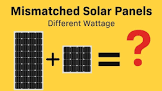
What Really Happens When You Mix Solar Panels of Different Wattages
One of the most common questions I get in solar discussions is this:
“I already have some solar panels. Can I just add bigger ones?”
Sometimes it’s 330W and 450W.
Sometimes 400W and 550W.
And the honest answer is: yes, you can mix them — but whether you should depends on how well you understand what happens electrically when you do.
This article explains it clearly, without shortcuts.
First, forget wattage for a moment
Most people focus on the wattage printed on the panel, but solar panels don’t actually “think” in watts.
What really matters are:
- Voltage (V)
- Current (A)
Wattage is simply:
Voltage × Current
So when you mix panels of different wattages, what you’re really doing is mixing panels with different electrical characteristics.
That’s where problems can begin.
What happens when panels are connected in SERIES
In a series connection:
- Voltages add up
- Current remains the same across the entire string
Here’s the critical part many people don’t realize:
In a series string, the panel with the lowest current limits the entire system.
So if you connect:
- A high-watt panel with higher current
- And a lower-watt panel with lower current
The bigger panel is forced to operate at the lower panel’s current.
The result:
- The system works
- But part of your panel capacity is wasted
- You don’t get the full power you paid for
A simple way to think about it
Imagine water flowing through pipes.
If one pipe is narrow, the flow is limited — no matter how wide the other pipes are.
That’s exactly what happens in a series solar string.
What happens when panels are connected in PARALLEL
In a parallel connection:
- Currents add up
- Voltage must remain the same
When you connect panels with different operating voltages in parallel, the system voltage settles closer to the lower-voltage panel.
The higher-voltage panel is dragged down.
The result:
- Power loss
- Reduced efficiency
- Possible heat buildup over time
Again, the system works — but not optimally.
“But I’m using MPPT” — let’s be honest
MPPT charge controllers are very useful, but they are often misunderstood.
MPPT:
- Optimizes the operating point of the entire array
- Does not optimize individual panels separately
So if your panels are poorly matched, the MPPT controller is simply choosing the least bad compromise.
It helps — but it does not fix bad design.
Real-world effects people don’t notice immediately
Mixing different wattage panels often leads to issues that show up later, not on day one:
- Lower daily energy harvest
- Panels aging at different rates
- Uneven heating (hot spots)
- More difficult fault diagnosis
- “The system works, but feels weak”
Nothing is broken.
It’s just inefficient.
When mixing panels can be acceptable
Mixing panels is not always wrong — if done properly.
It can be acceptable when:
- Panels have very similar operating voltage
- Same panel technology and cell count
- Each group is connected to a separate MPPT input
This is how professionals handle expansions.
When you should NOT mix panels
- New installations
- Systems with tight energy margins
- PWM charge controllers
- Installations where performance and longevity matter
If you’re starting fresh, matching panels is simply the smarter choice.
The bottom line
Mixing solar panels of different wattages is not illegal, and it’s not magic either.
Working is not the same as working well.
Good solar design is about:
- Electrical balance
- Efficiency
- Long-term performance
- Safety
Not just connecting wires and hoping for the best.
If your system feels underpowered despite “enough panels,” mismatch could be the reason.