Why Your Solar Panels Are Not Producing Their Rated Power — 15 Things Every Installer Should Check
One of the complaints I hear from solar customers is:
“Engineer, I bought 550W panels. Why am I only seeing 350W or 400W?”
Sometimes the customer is genuinely seeing lower production because something is wrong.
But sometimes the panels are working perfectly.
The problem is that many people think a 550W solar panel should produce 550W every time they look at the inverter.
It doesn’t work that way.
The number written on the panel is its rated output under specified test conditions. Real installations operate under changing conditions throughout the day.
As an installer, I don’t want to simply tell a customer, “That’s normal.”
I want to know why the production is lower.
Is it the weather?
Panel temperature?
Shading?
Dust?
String configuration?
PV voltage?
PV current?
Cable losses?
The inverter’s MPPT limitations?
Or is there actually a fault?
That distinction matters.
Here are 15 things I check when a solar array isn’t producing what the customer expects.
1. First, understand what the panel’s wattage actually means
Let’s start with the basics.
If a panel is rated at 550W, that rating comes from specified laboratory test conditions.
It doesn’t mean the panel will continuously deliver 550W on someone’s roof.
Real-world conditions are different.
Solar irradiance changes.
Temperature changes.
The angle of the sun changes.
Clouds move.
Dust accumulates.
There may be shading.
The panel itself gets hot.
The inverter has its own operating limits.
There are also electrical losses.
So if a 550W panel is producing less than 550W at a particular moment, that alone doesn’t prove anything is wrong.
What matters is whether the production is reasonable for the conditions and system configuration.
2. Check the time of day
This sounds obvious, but it gets overlooked.
Someone may check their inverter at 9am and complain:
“My 550W panels are only giving 200W!”
But solar production isn’t constant throughout the day.
Production generally increases as solar irradiance increases, reaches its strongest period around the middle of the day depending on location and conditions, and then falls again.
So when I’m investigating low PV production, I want to know:
What time was the measurement taken?
A reading at 8am shouldn’t be compared directly with a reading around solar noon.
And even solar noon doesn’t guarantee maximum output every day.
3. Check the weather
Nigeria gets plenty of sunshine, but that doesn’t mean every day provides identical solar conditions.
Cloud cover, haze, rain, Harmattan conditions and atmospheric dust can all affect available sunlight.
A cloudy day can produce dramatically different PV output from a clear day.
So before I start disconnecting panels and blaming equipment, I look at the environmental conditions.
If the entire array suddenly produces less power during heavy cloud cover, that may be perfectly normal.
If the weather is clear, irradiance is strong and one string is producing significantly less than another similar string, then I become more interested.
The key is to compare the reading with the conditions under which it was obtained.
4. Check panel temperature
This is one that surprises many customers.
Solar panels like sunlight, but that doesn’t mean they perform better simply because the panel is extremely hot.
PV electrical characteristics change with temperature.
As module temperature increases, voltage generally falls.
This can reduce the panel’s operating power compared with its rated performance under standard test conditions.
So a panel sitting under strong Nigerian sunshine can be exposed to excellent irradiance while also operating at a high temperature.
That’s one reason you shouldn’t expect the nameplate wattage to appear constantly on a hot afternoon.
When assessing performance, I consider both irradiance and temperature.
5. Look for shading
A small amount of shading can have a surprisingly large effect depending on where it falls and how the panels are electrically configured.
Things I check include:
- Trees
- Buildings
- Water tanks
- Satellite dishes
- Poles
- Walls
- Nearby structures
- Roof features
- Other panels
And I don’t only check for obvious midday shadows.
The position of the sun changes throughout the day.
A roof that looks completely clear at noon may have partial shading in the morning or late afternoon.
If the system consistently underperforms at certain times, I want to know what is happening on the roof at those times.
6. Check whether the panels are dirty
This is particularly relevant in Nigeria.
Dust, Harmattan particles, bird droppings and other dirt can accumulate on modules.
A panel doesn’t need to look completely covered in dirt before its performance can be affected.
If the installation is in a dusty environment, near a busy road or somewhere with significant airborne particles, I pay attention to the condition of the modules.
But I also don’t recommend blindly washing panels every day.
Cleaning frequency should make sense for the site and conditions.
The point is simple:
A dirty panel cannot perform like a clean panel under identical conditions.
7. Check the panel specifications
When troubleshooting a PV array, I don’t want to hear only:
“They’re 550W panels.”
I want the actual datasheet.
I need to know parameters such as:
- Voc
- Vmp
- Isc
- Imp
- Rated power
- Temperature coefficients
Two panels can both be described as “550W” while having different electrical characteristics.
Those differences matter when designing strings and connecting the array to an inverter.
This is one reason I always prefer working from the manufacturer’s specifications rather than assumptions.
8. Check the string configuration
This is where an installer needs to slow down.
Suppose you have several panels connected in series.
Their voltages add together.
When panels are connected in parallel, current characteristics become relevant.
So I want to know:
How many panels are in each string?
How many strings are connected to each MPPT?
What is the expected string voltage?
What is the expected current?
Does the configuration fall within the inverter’s limits?
It isn’t enough to say:
“There are 10 panels, so everything is fine.”
Ten panels connected incorrectly can be a problem.
PV configuration is part of system sizing.
For installers who want to check the broader system requirement before making these decisions, the Globisun Solar App can also help with solar calculations.
Download the Globisun Solar App for solar sizing
9. Check the inverter’s MPPT voltage range
Every MPPT has an operating range.
The PV array needs to operate within that range for the inverter to track the solar input correctly.
This is why I don’t select a panel configuration just by adding up the wattage.
I look at the actual voltage.
For example, if the string voltage is outside the inverter’s appropriate MPPT operating range, the system may not perform as expected even if the total panel wattage looks impressive.
Always check the inverter’s manual.
Don’t rely on:
“I’ve connected this number of panels to this inverter before.”
Different inverter models can have different specifications.
10. Check the maximum PV voltage
This is not the same thing as the MPPT operating range.
An inverter can have a maximum allowable PV input voltage.
The array’s open-circuit voltage needs to remain within the inverter’s maximum limit under the relevant temperature conditions.
And this is where temperature becomes particularly important.
PV Voc changes with temperature.
So when calculating a series string, don’t simply multiply the panel’s nominal Voc by the number of panels and stop there.
The temperature coefficient needs to be considered.
A configuration that looks fine under one condition could approach or exceed the inverter’s maximum input voltage under another condition.
This isn’t just about performance.
It is a safety and equipment-protection issue.
11. Check the inverter’s maximum PV current
Voltage isn’t the only thing that matters.
Current matters too.
Some modern solar panels have relatively high current characteristics, and some inverters have specific MPPT current limits.
So if an installer connects multiple strings to an MPPT without checking the current limits, the inverter may not be able to utilise all the available PV power as expected.
This is why I check both sides:
What can the panels produce?
and
What can the inverter accept?
The lower limitation can determine how much of the available PV power is actually usable.
12. Check the cables and connections
Sometimes the problem isn’t the panel at all.
It is the connection between the panel and the inverter.
I check:
- PV cable size
- Cable length
- MC4 connectors
- Crimping
- Loose connections
- Damaged insulation
- Corrosion
- Connector compatibility
- Voltage drop
A poor connection can create resistance and losses.
A damaged or badly crimped connector can also become a heat source.
And if you have a long PV cable run, voltage drop becomes something worth checking rather than assuming it doesn’t matter.
The panel can be producing properly at the roof while the inverter receives something different.
13. Compare strings instead of looking only at total PV power
This is one of my favourite troubleshooting methods.
If you have multiple similar strings, compare them.
Suppose you have two strings with the same number and model of panels, similar orientation and similar environmental conditions.
If one is producing significantly less than the other, I start investigating.
I might check:
- String voltage
- String current
- Connections
- Shading
- Panel condition
- String configuration
- MPPT assignment
This is often more useful than simply looking at the total PV figure on the inverter.
A total figure can hide a problem in one part of the array.
14. Check whether the inverter is limiting PV production
This is another issue that can confuse customers.
Imagine the solar array can produce more power than the inverter can accept or process under the manufacturer’s specified limits.
The inverter may limit the PV power.
So the customer looks at the screen and says:
“I have 8kW of panels. Why am I only seeing 6kW?”
Before declaring the panels faulty, I check the inverter’s PV input specifications and operating behaviour.
PV oversizing can be a legitimate design strategy on some inverter models when it is explicitly supported by the manufacturer.
But there is a difference between permitted PV oversizing and simply connecting more panels without checking the inverter’s limits.
Always work from the manufacturer’s specifications.
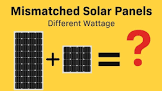
15. Don’t forget panel mismatch
If you mix different panels, you need to understand what you’re doing.
Different:
- Wattages
- Voc
- Vmp
- Isc
- Imp
- Electrical characteristics
can affect how panels behave when connected together.
Even panels from the same manufacturer can have different electrical characteristics across models.
This is why I don’t recommend randomly adding whatever panel is available to an existing array.
If the customer says:
“I bought four more panels. Just add them.”
I want to know exactly what those four panels are.
The question isn’t simply whether they physically fit on the roof.
It’s whether they electrically belong in that system.
How I troubleshoot low PV production in the field
When a customer calls and says:
“The solar panels are not producing.”
I don’t immediately climb onto the roof.
I start with the inverter.
What is the PV voltage?
What is the PV current?
What is the PV power?
Which MPPT is receiving the input?
What time was the reading taken?
What are the weather conditions?
Then I compare the readings with what I expect from the system.
If the array has multiple strings, I compare them.
If something doesn’t make sense, I move further down the chain.
I check the PV configuration.
Then the connections.
Then the panels.
Then the inverter settings and specifications.
The goal is to find the point where the expected behaviour stops matching the actual behaviour.
That is much better troubleshooting than simply saying:
“The panels are bad.”
Don’t judge a solar panel from one inverter reading
This is something I tell customers quite often.
If you look at your inverter at 10am and see 2.5kW from a 5kW array, that single number doesn’t tell me enough.
I want context.
What was the weather?
How hot were the panels?
Was there shading?
What direction are the panels facing?
Were there clouds?
Was the battery already full?
Was the inverter limiting PV?
What was the MPPT voltage?
What was the current?
Was the customer consuming power at the same time?
One reading is a snapshot.
Good troubleshooting looks at the whole picture.
A proper solar system starts before installation
The performance of the PV array is influenced by decisions made before the panels ever reach the roof.
The customer’s energy requirement needs to be understood.
The inverter needs to be selected appropriately.
The PV array needs proper sizing.
The string configuration needs to be calculated.
The inverter’s voltage and current limits need to be checked.
The roof needs to be assessed.
The installation environment needs to be considered.
This is why I don’t believe in the habit of simply saying:
“Let’s use 550W panels because everybody is using 550W panels.”
The panel wattage is only one part of the system.
If you’re an installer, the Globisun Solar App can be useful when planning a system because it helps you work through the customer’s load and solar sizing requirements before you start buying equipment.
It also includes other solar-related tools and information that can be useful during your work.
So, are your panels actually underperforming?
Maybe.
But don’t make that conclusion simply because the inverter isn’t displaying the number printed on the panel.
A 550W panel producing 400W under certain conditions isn’t automatically faulty.
But if the array consistently produces unusually low power under strong sunlight, with clean panels, no shading and correct system configuration, then you have something worth investigating.
That’s where an installer earns his money.
Not by looking at the screen and guessing.
Not by blaming the customer.
Not by replacing panels unnecessarily.
Measure. Compare. Check the specifications. Trace the problem.
I’ve learned that good solar troubleshooting is less about guessing what went wrong and more about proving what went wrong.
And when a customer calls me saying:
“Engineer, these panels are not giving me what I paid for.”
My first response shouldn’t be:
“The panels are bad.”
It should be:
“Let’s check the system and find out exactly why.”
Because sometimes the panel is the problem.
But sometimes the panel is the most innocent component in the entire installation.